Tuesday, May 14, 2013

Lecture on National Climate Assessment up


As part of the on-line ecosystem ecology course I am putting together, I uploaded a series of lectures on the National Climate Assessment. 

In total, about 30 minutes of summarizing some of the main points about changes in climate that were presented in the draft version of the National Climate Assessment.

It's still one of the most amazing scientific documents one can read.

And scary.

If you don't read the document, it couldn't hurt to view this.

Link to YouTube Playlist is here.

Sunday, May 12, 2013

Bison Natural History: Modern Megafaunal Dispersal


One of the curious things at Konza is the dispersal of Gleditsia tricanthos (locust). Gledtsia has pretty big seeds encased in large pods that were likely dispersed by megafauna. Yet, even today you can find isolated seedlings/saplings pretty far from the parent tree. 

What was moving the seeds?

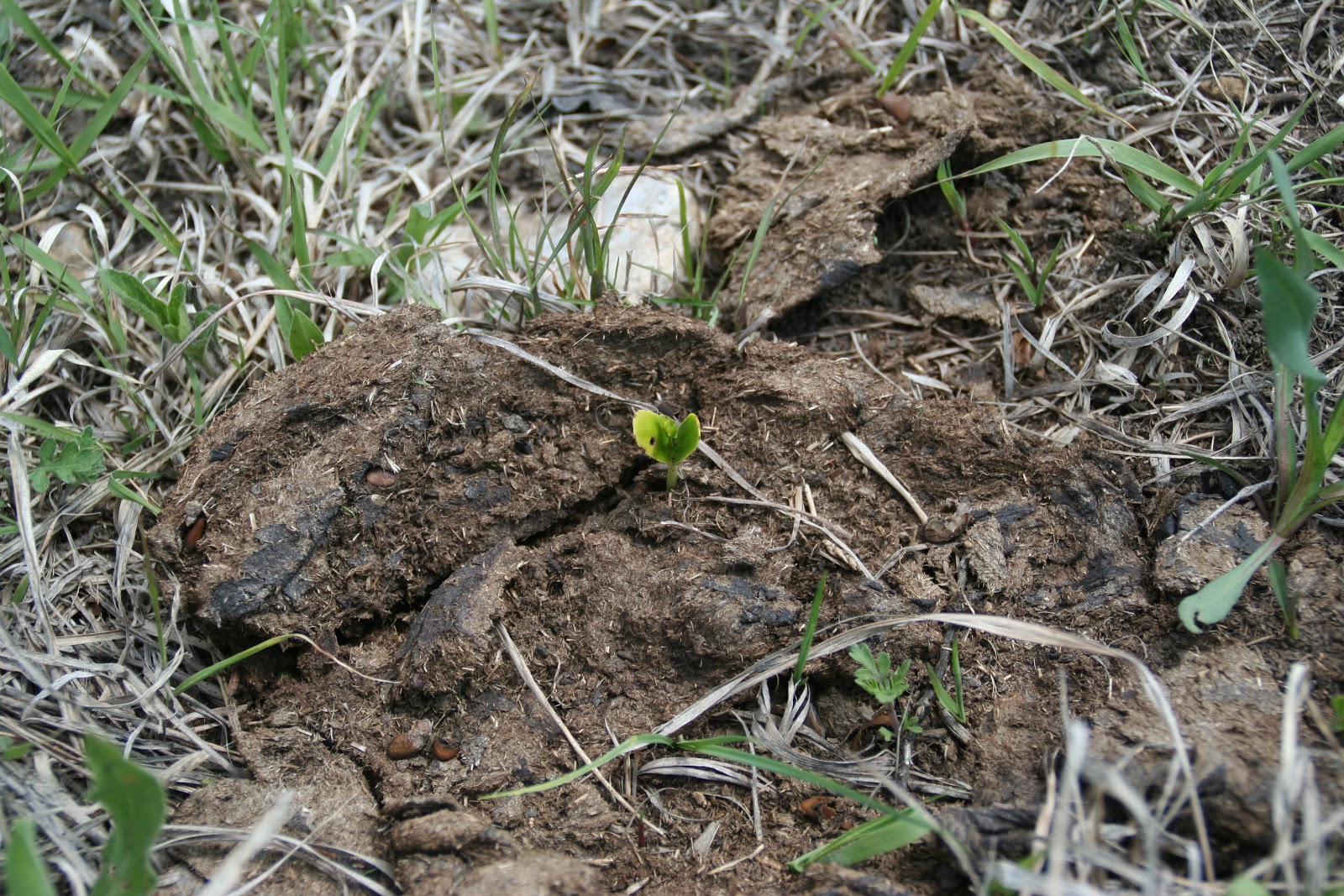
This winter I noticed that bison dung at Konza was packed with locust (Gleditsia) seeds. 

This spring, it's clear that they are germinating in the dung.


Something I had never noticed before, but pretty clear now.

Bison eat and disperse the seeds of trees. 


New paper on soil N isotopes


Quick note on an interesting paper regarding soil N isotopes.

Cohen et al. synthesized about 100 soil samples for C:N and 15N. They found a good relationship between soil C:N and 15N. Beyond this, those soils that were considered "perturbed"were more elevated at a given C:N.

They felt that overgrazing or fire led to enriched 15N when compared at a given C:N.

In conclusion, they state "The d15N natural abundance values, when related to the C:N ratios, may readily indicate perturbation of soil N cycling prior to other..."


Conen, F., M. V. Yakutin, N. Carle, and C. Alewell. 2013. delta(15) N natural abundance may directly disclose perturbed soil when related to C:N ratio. Rapid Communications in Mass Spectrometry 27:1101-1104.

Monday, April 22, 2013

Grazing and diet


Here's a quick note on a neat paper.

Grazers have a tough choice sometime.

Eat grass. It doesn't taste bad, but often doesn't have high protein concentrations.

Eat forbs. They often have higher protein concentrations, but taste bad.

And they taste bad because they have compounds that reduce the digestibility of food or make them ill.

Many grazers try a balance. Eat forbs, but not enough to make them sick.

What happens when you supplement grazers with protein? Is there any reason to still eat forbs?

Not much.

Supplement cattle in Kenya with protein (during the dry period) and their forb intake drops by 76%.

Many grassland managers manage for grass, but forbs can provide an important part of their diet. It's hard to manage for diversity, but if we can figure out how to do it well, there are economic and conservation benefits.


Odadi, W. O., M. K. Karachi, S. A. Abdulrazak, and T. P. Young. 2012. Protein supplementation reduces non-grass foraging by a primary grazer. Ecological Applications 23:455-463.

Saturday, April 20, 2013

Fire and soil moisture


Fire is an integral part of ecosystems especially grasslands and savannas. Many of these ecosystems burn regularly. And shutting off fire radically alters their dynamics.

Some of fires impacts on ecosystems are direct. Fire directly removes biomass and kills some plants.

But the impacts on other factors, like soil moisture, are relatively indirect. Fire evaporates some water directly, but its influence on soil moisture occurs by impacting community composition, litter layers, or nutrient availability.

For example, the removal of litter layers by fire can either lead to net increases or decreases in soil moisture. On the one hand, litter layers decrease evaporation and transpiration, but they also intercept precipitation from reaching the soil.

Fires also differentially impact woody species. And woody species aren't suppressed by litter layers and   can tap deeper water stores.

At Konza, Jesse Nippert and I went through 28 years of soil moisture data from an annually burned watershed and another that had prescribed fire shut off (except one wildfire in 1991).

Examining biweekly soil moisture over 28 years is pretty amazing. I'm not sure there is a long-term dataset like this anywhere in the world.

What happens to soil moisture when you shut off fire for 27 of the 28 years? Do the soils get wetter or drier? Do plants become more water stressed or less?

Turns out it depends on how long after fire gets shut off.

Overlay of woody species cover (open circles) and the difference in soil moisture between an infrequently (20b) and annually burned (1d) watershed. Soil moisture data presented for all depths from 25 to 150 cm. Piecewise linear regression used to generate pattern of soil moisture at all depths over time. Note what happened in 1991. Soils got a lot drier in the watershed that had been unburned, even drier than the annually burned watershed, as productivity exploded. 
In the short-term, litter from the dead grasses accumulates and soil moisture is less depleted most likely due to reduced evaporation and transpiration.

But in the long-term, wood species move in and they start to draw down soil moisture levels. Especially in the deeper soil profiles.

So, in the end, shutting off fire keeps soils wetter in the short-term, but dries soils long-term. 


Teaching Ecosystem Ecology On-line

This fall I led a survey of how ecosystem ecology is taught in the US. The results were stunning.

Approximately 1300 students a year take a course on the topic. 40% of the students are at just 10 institutions.

In terms of dollars, it means that about $1.5 million a year is spent on learning ecosystem ecology at the undergraduate level.

That's not much.

More courses need to be taught at more institutions. Ecosystem ecology needs to be part of a balanced curriculum.

Convincing departments of the merits of this is not easy. It requires influencing hiring decisions and allocation of effort.

Beyond that, we need more opportunities for non-traditional students. High school teachers and practicing ecologists need the opportunities to continue their education.

It seems like an online course is the best way to making ecosystem ecology available to more people.

For about the past two months I've been working on doing that.

I'm working on putting together a full on-line course on ecosystem ecology based on the Chapin, Matson, Vitousek textbook. The course can be taken by anyone for credit through KSU's Division of Continuing Education. It's being offered starting in the Fall.

A few thoughts on the process of putting together an on-line course.

An on-line course is a good way to deliver content compared to a typical lecture. All the lectures are narrated slide shows with more interesting videos interspersed. The course gets broken up into 5-10 minute chunks which don't strain attention spans. The quality of the material is often better, too. As an instructor, I can edit out mistakes and do retakes. No one has a bad seat. You can snack and talk. You don't have to look at me.

It's easy to weave in multimedia content. I can break up lectures with videos of me in the field or animations of global atmospheric circulation in ways that are difficult in the classroom.

Lecturing to a computer is not as strange as I thought. I become hyper-aware of short pauses though. I've said the word "um" three times so far and each time it's like nails on a blackboard.

Once the slides are done, it takes me about 2.5 h to put together an hour of lecture. That includes reading through the chapter again, looking over and fixing slides, narrating the video, renarrating when I mess up, and editing things into smaller chunks.


I give my lectures in my home "study-o". It's quiet there, but sometimes the doorbell rings.


There are certainly drawbacks compared to the ideal--a field course with 10 people and an instructor--but its not meant to replace that.

I'll write more when things get further along.

In the meantime, a course website is up at ecosystemecology.org. It'll have a sample lecture and some other information.

Friday, March 22, 2013

Changes in nitrogen cycling over the past 15 thousand years

Figure 2 | Changes in lacustrine sedimentary d15N during the late Pleistocene and Holocene. a, A smoothing spline curve (0.05 smoothing parameter) fitted to the means of sites in 100-yr bins is shown (red) with 95% bootstrapped confidence intervals (grey). Declines in sedimentary d15N from 15,000 cal. yr BP  to the breakpoint at 7,0566597 cal. yr BP correspond with periods of global net terrestrial carbon gain (shaded green)4. Dotted black line is the breakpoint regression. b, A different set of high-resolution sedimentary d15N records shows no net change over the past 500 yr.

Just a quick note to say that Kendra's paper on reconstructing N availability was just published.

It's an amazing synthesis.

What makes it amazing is the ability to look back in time at an index of terrestrial N availability and see that for thousands of years during the Pleistocene-Holocene transition.

As interesting, there just wasn't any evidence of N availability increasing over the past 500 years.

Whether N availability--the supply of N relative to biotic demand--is increasing at the global scale is one of the most fascinating debates that isn't occurring.


McLauchlan, K. K., J. J. Williams, J. M. Craine, and E. S. Jeffers. 2013. Global nitrogen cycling changed during the Holocene as terrestrial ecosystems accumulated carbon. Nature 495:352-355.