Showing posts with label water potential. Show all posts

Saturday, January 14, 2012

Why trees die: case example


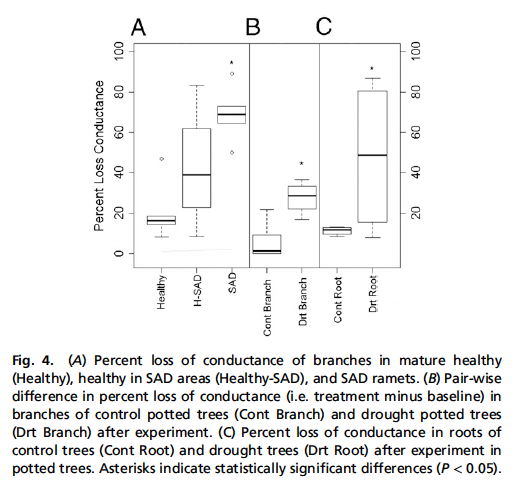
Understanding mortality in plants is a tangle of proximal and distal as well as competing hypotheses. A recent paper in PNAS tried to disentangle a number of issues for understanding mortality in trembling aspen (Populus tremuloides).

The authors use a mix of gradients and experiments to examine patterns of carbohydrate reserves and hydraulic properties for droughted and non-droughted aspen plants. Plants that were droughted and non-healthy did not have reduced carbohydrate levels in their tissues (leaves or roots). In contrast, dying plants consistently were experiencing loss of hydraulic conductance and cavitation.

What is interesting here is that aspen is the lettuce of trees. It is an isohydric, physiologically drought-intolerant species. The research shows that pot experiments should be pretty good at determining the drought tolerance characteristics of species. Screening experiments (and rated, more involved detailed studies like these) should allow for the type and degree of drought tolerance to be assessed for other  species. hence, models of future mortality could be generated for forests across the world.


Anderegg, W. R., J. A. Berry, D. D. Smith, J. S. Sperry, L. D. Anderegg, and C. B. Field. 2012. The roles of hydraulic and carbon stress in a widespread climate-induced forest die-off. Proceedings of the National Academy of Sciences of the United States of America 109:233-237.

Monday, October 12, 2009

Canopy interception and the dispersed puddle


Taking a walk through grass after a light rain is a soaking affair. Even walking through a recently mowed lawn in the morning would wet your sneakers while going to school. It was always better to let the sun come out for a little bit before short-cutting across a yard.

The principle that most children learn at a young age likely has important ramifications for understanding the dynamics of how grasslands work. Through one of two mechanisms, my guess is that canopy interception sets up a negative feedback loop that constrains how much grass is produced.

First, a quick review.

In grasslands, approximately half of the precipitation can be intercepted by biomass without reaching the soils. For small precipitation events, 70% of the precipitation can be intercepted by a dry canopy, with the fraction of precipitation intercepted declining with event size (Ataroff and Naranjo 2009). A single square meter of grassland can withhold 2 L of water from reaching the soil.

Relationship between precipitation and canopy interception for a tropical pasture grass. From Ataroff and Naranjo 2009.

Half of the precipitation that could fall on a grassland might never reach the soil. And the more grass there is, the less precipitation would reach the soil. Seasonally, as grass grows and canopies develop, the demand for water would be ever increasing. Yet, because of interception, less and less precipitation would reach the soil.

Increasing demand, decreasing supply. A classic negative feedback that would be limiting growth. Even if plants had access to deep water, the consequences might be greater for N supply and cause transitive limitation as surface soils where N mineralization occurs would be prevented from rewetting.

Evolutionarily, we haven't explored whether there would be selection on herbaceous species to promote (or not promote!) throughfall of precipitation. Altered leaf angle, waxy cuticles, stemminess, would all alter how much water is retained or passed on to the soil. Ecologically, with just a few papers on the topic, there are likely some large unexplored ramifications besides promoting seasonal water limitations. For example, from first principles, rain coming in larger events should promote growth, not retard it, as the water is stored in the soil rather than the canopy.

Most importantly of all, if you haven't learned it yet, never cut across a wet lawn in the morning wearing sneakers. Might as well jump in a puddle.

Wednesday, June 24, 2009

Water linking roots, stems, and leaves

Selection on plants has always worked to coordinate the functions of all the plant parts together. Demand must be coordinated with supply. The demand for N and water by leaves cannot outstrip the ability of roots to acquire them, or stems to move them. Root growth needs to be in balance with shoot carbon supply. 

Bucci et al. just published a nice study on the coordination between roots, stems, and leaves for moving water among Patagonian woody species. Deeply rooted species have access to lots of water at all times. Shallowly rooted species undergo periodic water stress as the shallow soils dry out. 

They found that deeply rooted species had low hydraulic conductivity (water moves slow through stems and leaves), low SLA, and high wood density. The shallower-rooted species, even though they were frequently under water stress, had high conductivity in stems and leaves, high SLA, and low wood density.

The patterns are great, but I think the authors interpret the patterns wrong. Plants with access to lots of water and no water stress should have high conductivity, not low. Why if the shallow species frequently experience severe water stress wouldn't they be more resistant to cavitation, which would lower conductivity? The authors state that "It appears that the marginal cost of having an extensive root system (e.g., high Rho_w and root hydraulic resistance) contributes to low growth rates of the deeply rooted species." 

More likely, all the nutrients are in the shallow soils and the deeply rooted species are adapted to low nutrient availability. The shallow species have periods of high nutrient availability and need to grow quick. It's the high resource strategy, which can end catastrophically if soils dry out too quickly, but also ends by the superior canopy of faster-growing competitors if they are built to withstand drying later.

Thursday, June 4, 2009

Why do plants close their stomata at night?


As the sun sets each night, most terrestrial plants close their stomata. It is reasoned that plants open their stomata to acquire CO2. At night, with no photosynthesis, there is no need to acquire CO2, and so the stomata can close.

Mike Cramer and coauthors just published a review in Oecologia that challenges some basic assumptions of the benefits of closing stomata at night. The authors state that mass flow of water to roots carries nutrients with it. For non-limiting nutrients, this flux alone can meet a plant's demand, but also could benefit the plant for a limiting nutrient that has low concentration in the soil solution. They cite many instances where NO3- can regulate water inflow into a root as additional evidence of the role of mass flow in plant nutrient acquisition.

In their summary, the authors state that "some plants [might be] designed not to conserve water, but rather to maximise the flux of water when it is abundant." This is a gauntlet-throwing statement. 

The calculations of the role of mass flow in nutrient acquisition are 30+ years old. This doesn't make them wrong, but the models did not always ask the most pertinent questions. Would a plant competing against another plant be benefitted from a higher transpiration rate? Would a plant that keeps its stomata open at night acquire more nutrients than one that keeps them closed? And even if not, what are the negative consequences to a plant that left them open? 

It's good that the authors raise such a basic question about how plants acquire resources from the soil. It's a good review that lays bare some fundamental questions about the constraints faced by terrestrial plants and ultimately their evolution.

Cramer, M. D., H. J. Hawkins, and G. A. Verboom. 2009. The importance of nutritional regulation of plant water flux. Oecologia.

Sunday, February 22, 2009

Transitive limitation and precipitation


Thinking more about N and water, I was looking over the Huxman-Smith et al. 2004 Nature paper. This paper summarizes the sensitivity of ANPP to precipitation. With data from 14 sites, they calculate rainfall use efficiencies across years to see how RUE changes with mean annual precipitation. They find that wetter sites have lower RUE, but all sites converge on a constant RUE. (Above figure is precipitation vs. ANPP (g m-2), each x-axis tick is 500 mm y-1).

The most interesting art of the paper are statements on resource limitation.

Here are some key sentences:

1) the authors predict that “the removal of other resource limitations so that precipitation becomes the primary limiting resource will result in an increase in site-level RUE that approaches RUEmax.”

2) “sites with high production potential in years with greater than average precipitation, soil nitrogen or other limiting resources might transiently limit biological activity.”

3) They also state that “biogeochemical constraints (limitation of activity by resources other than water) can increase with increasing precipitation”.

The approach the authors take to limitation is generally one of serial limitation. First one resource limits, and then another. The authors seem to hold the idea that multiple resources can co-limit ANPP, but they are mute about mechanisms or what the tradeoffs are. There is no evidence they considered substitutability leading to co-limitation, or transitive limitation (water limiting N availability). Looking at statement 3 above, they just as easily could have said that biogeochemical constraints can also decrease with increasing precipitation.

The unstated model they use follows something like this: less rain, greater water stress, less limitation by other resources, less production, greater WUE.

The existence of transitive limitation changes the entire story of ANPP responses to increased precipitation: less rain, less nitrogen mineralized, greater limitation by N, less production.

The relationship between ANPP and precipitation is, here, just a ratio. The important part of research is always to look one level of mechanism below the pattern of interest.

For example, if plant WUE was a key factor in RUE, then wouldn’t sites dominated by C4 vegetation have an inherently higher RUE than sites dominated by C3 vegetation? But, if the observed RUE was driven by N mineralization responses to increased soil moisture, wouldn’t they be the same? Although Cedar Creek (CDR) might show no increase in ANPP with increased precipitation due to strong N limitation, there might be unique patterns of sensitivity of N mineralization to variation in precipitation there. For example, maybe with the sandy soils, soil moisture isn't much greater in a high precipitation year.

At this point, both mechanistic hypotheses should be considered equally (one can’t be favored because it comes first). It’d be interesting to see how much of the patterns could be explained by transitive limitation.

Huxman, T. E., M. D. Smith, P. A. Fay, A. K. Knapp, M. R. Shaw, M. E. Loik, S. D. Smith, D. T. Tissue, J. C. Zak, J. F. Weltzin, W. T. Pockman, O. E. Sala, B. M. Haddad, J. Harte, G. W. Koch, S. Schwinning, E. E. Small, and D. G. Williams. 2004. Convergence across biomes to a common rain-use efficiency. Nature 429:651-654.
Thursday, January 8, 2009

Drought and isohydry

I recently had the chance to read "Mechanisms of plant survival and mortality during drought: why do some plants survive while others succumb to drought?", which is a Tansley review in New Phytologist by Nate McDowell and others. One thing I really liked about their paper was the dichotomy between two potential strategies for coping with drought. The anisohydry strategy has plants experiencing lower leaf water potential as soils dry, but maintaining photosynthesis and transpiration throughout the drought. These plants are typical "low-water" species with all the anatomical traits that resist cavitation. The other strategy is to avoid drought through stomatal closure, maintaining more constant leaf water potentials. This is termed an isohydric strategy.

The latter strategy is interesting in that "drought-avoidance" is usually considered to be associated with little ability to withstand drought causing plants to die back or complete a generation until drought is relieved. Instead of the succulent strategy, where plants store water, the isohydry strategy requires plants to store carbon.

The paper is intriguing and I have a few questions about the generality of the isohydry strategy. Here are two:

1) It isn't clear that many species with low psi-crit's store a lot of C to endure drought. For example, I can't think of many herbaceous grassland species that use stored carbon to maintain a plant after leaves have closed their stomata.

2) After plants close their stomata, as soils continue to dry, plant water still comes under increasing tension, unless plants can hydraulically isolate themselves from the soil. The authors allude to this, but I'm not sure I understand how viable a strategy it is to close your stomates and wait for rain. Are plants more likely to run out of carbon before they cavitate? 

A lot of plants have big carbon stores that we don't know when they are used. This might explain some of those patterns.

Good job to the authors on the paper. It'll be interesting to see the ideas developed more and the hypotheses tested in other systems.