Friday, January 27, 2012

The indirect effect of drought on plants


The direct effects of stresses on plants are often fatal (making them disturbances, by definition). For example, drought can cause cavitation in a plant's xylem, which leads to tissue desiccation and ultimately death. But, the indirect effects of stresses can cause mortality, too. Stresses can reduce the defense systems of plants allowing pests and pathogens to kill plants before the direct effects of drought ever do. Direct tests of the generality of this principle are uncommon though.

Jactel et al. recently published a meta-analysis of the effects of drought on damage to trees by insects and pathogens. The results were neat. They found that agents that attack plant leaves were enhanced by water stress to plants. Yet, agents that attack the plant through its wood caused less damage to water-stressed plants than to unstressed plants.

The best part of the paper was linking the degree of water stress to the severity of damage (shown above). Their metric was the reduction in plant water potential relative to the water potential at which conductance is reduced by 50%. The greater the severity of water stress, the greater the damage.

Well done.


Jactel, H., J. Petit, M.-L. Desprez-Loustau, S. Delzon, D. Piou, A. Battisti, and J. Koricheva. 2012. Drought effects on damage by forest insects and pathogens: a meta-analysis. Global Change Biology 18:267-276.

Saturday, January 14, 2012

Submissions to NSF


David Inouye posted this to Ecolog. I'm not sure where he got it, but it looks pretty real.

The key here is that the number of proposals to DEB has been going up while award numbers have been flat, leading to a decline in success rate.

NSF knows there is pain out there and has worked to respond to the pain on reviewers.


More proposals means more reviews.

NSF has the power to reduce the burden on reviewers, so they instituted a pre-proposal stage with 4-page pre-proposals and a limit on the number of proposals a person can submit as a pi or co-pi. Some have argued that this reduces this stage of evaluation to a raffle that can harm early-career and soft-money scientists. 

The key here seems to be what the funding rate should be. Or even better, what the total level of funding should be. Congress determines this. 

My guess is that the policies of NSF now are less of a burden to good science than funding levels, but NSF is more proximal. It will be interesting to see if more effective arguments can be made to raise the level of funding.


Why trees die: case example


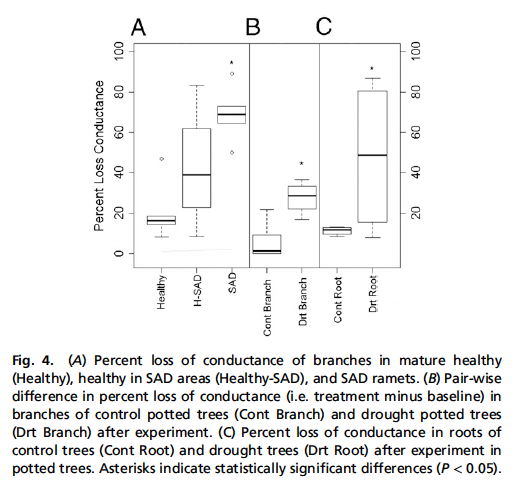
Understanding mortality in plants is a tangle of proximal and distal as well as competing hypotheses. A recent paper in PNAS tried to disentangle a number of issues for understanding mortality in trembling aspen (Populus tremuloides).

The authors use a mix of gradients and experiments to examine patterns of carbohydrate reserves and hydraulic properties for droughted and non-droughted aspen plants. Plants that were droughted and non-healthy did not have reduced carbohydrate levels in their tissues (leaves or roots). In contrast, dying plants consistently were experiencing loss of hydraulic conductance and cavitation.

What is interesting here is that aspen is the lettuce of trees. It is an isohydric, physiologically drought-intolerant species. The research shows that pot experiments should be pretty good at determining the drought tolerance characteristics of species. Screening experiments (and rated, more involved detailed studies like these) should allow for the type and degree of drought tolerance to be assessed for other  species. hence, models of future mortality could be generated for forests across the world.


Anderegg, W. R., J. A. Berry, D. D. Smith, J. S. Sperry, L. D. Anderegg, and C. B. Field. 2012. The roles of hydraulic and carbon stress in a widespread climate-induced forest die-off. Proceedings of the National Academy of Sciences of the United States of America 109:233-237.

Saturday, December 17, 2011

Best use of bootstrapping, ever: the flavor network.

Not too often, a paper comes out that generates so much insight and is presented so elegantly that it induces jealousy.


Ahn et al. published a paper in Scientific Reports (Nature's version of PLOS), "Flavor network and the principles of food pairing". Essentially, the paper mined on-line recipe databases to generate differences in ingredient use and flavor-space among cuisines.


Each figure in the paper has so much that is interesting. At the center of a giant multivariate analysis of flavor is what Kendra called the "triangle of happiness": cocoa, beer, and coffee. At the center of that: katsuobushi--dried, shaved bonito tuna. It must be amazing. Liver by the way shares little in the way of flavors with anything else (thankfully).


The authors also use bootstrapping to see which are the most unique ingredients in different cuisine's recipes. North America clearly stands out for its desserts. Take away: milk, butter, cocoa, vanilla, cream, cream cheese, egg, peanut butter, and strawberries and our recipes are pretty similar to elsewhere in the world. Essentially it's our ice creams and cheese cakes that make us stand out.


So much about the food of the world, jammed into one paper. Blue cheese and chocolate share 73 flavor compounds? Throw away line.


This is an amazing food paper, yet I can't help think about why we can't do this for plants. Substitute regional flora for cuisines,  functional groups for ingredients, and functional traits for flavors and it would be once-in-a-century paper. Yet, you look at the underlying data for this paper and realize that paper is a century away.


http://www.nature.com/srep/2011/111215/srep00196/full/srep00196.html#/f2

Friday, December 9, 2011

Graphs that don't exist: state factors and shade


Shade, drought, and nutrient scarcity are three resource stresses that constrain vegetation globally. Each of these are influenced by state factors as well as other more proximal controls on ecosystem function.

At least theoretically. We've actually never tested these ideas, which constrains our ability to explain and predict a lot about how ecosystems work.

Take shade. Plants produce leaves, which creates shade beneath them. Yet, the amount of shade in different stands varies tremendously. Theoretically, sites that are more limited by water should be able to produce less leaf area, leaving more light to the understory and removing a constraint on the growth of understory vegetation.

Despite decades of light measurements and hemispherical photographs of canopies, the data has never been synthesized to generate a global map of shade that can be analyzed in terms of determinants. Do dry ecosystems have a lower potential for producing shade than wet ecosystems? And how does that vary with temperature? Do forests in colder regions cast less shade, all other things equal?

Part of this echoes Peter Grubb's assertion that higher fertility sites should generate more shade and have more slow-growing shade-tolerant species, which still hasn't been tested directly as far as I can tell.

What holds for shade also holds for nutrient availability and water potentials. We just don't know the basic drivers of resource availability and hence don't know how global change factors like warming will affect the availability of the most limiting resources.


Wednesday, December 7, 2011

Global change and limitation

Ternary diagram showing the inverse relationships among low resource stresses and how global change factors influence the likelihood of resource limitations.
One foundation of ecology lies in the concept of state factors. Borrowed from soil science, state factors are the properties of ecosystems that are independent of the properties of the ecosystems [see earlier post]. The bedrock under a stand of plants is largely independent of whether a forest is there or we cut it down.

Ecosystems are not entirely deterministic from state factors and there are more proximal "interactive controls" like disturbance that are co-influenced by the vegetation. The probability of fire depends on what species are present as well as state factors like macroclimate.

One deficiency in our application of state factors and interactive controls has been to map the influence of state factors and interactive controls onto limitation. What factors and controls promote water-limitation over nutrient-limitation?

I've been trying to diagram this. Terry in his ecosystem book used a flow-control diagram to map the relative influences of state factors, interactive controls, and other controls on processes.


I've tried this approach for generating limitation and my diagrams come out looking like spaghetti. Or fettuccine. Some type of long, linear pasta. At least not fusilli thankfully.

The best I can come up with is a ternary diagram. In short, we want to show that drought, shade, and nutrient scarcity are all inversely related. And that a given global change factor promotes one or two stresses over the other. Precipitation promotes shade and nutrient scarcity over drought stress. Warmer temperatures promote drought and shade over nutrient scarcity. Disturbances reduce resource stress overall (inset).

There are dependencies for the diagram, e.g. chronic vs. catastrophic fire or scarcity of N vs. P.

Still I think this encapsulates the concepts we have about how global change factors alter limitation.

Mapping out other specific state factors is still a challenge. I get more spaghetti diagrams when I do this. Well, diagrams that look like I spilled dried spaghetti.

Thursday, December 1, 2011

The proximal should precede the distal

Relationship between water potential at which a species loses 90% of conductivity and dry season mortality. From Pratt 2008.  

When it comes to explaining patterns associated with the ecology of plants, a simple dictum should apply: the proximal should precede the distal.

I've been working with a few others to try to make this point with plant functional traits and ecological patterns for a review that Science green-lighted. In short, when looking to explain ecological phenomena, the mechanisms explored should be the closest to the mechanisms that generate the pattern. 

If drought is thought to cause mortality in a system and one is trying to understand which plants would survive drought the best, measure whole-plant drought tolerance first. Then begin to examine more distal underlying traits. Don't start measuring traits like SLA or screening genes until drought tolerance has been quantified.

Pratt et al. 2008 show a good example of the approach. The authors grew up a series of chaparral species from seed and monitored their performance over a dry summer. Those species that could withstand low water potentials the best, suffered lower mortality.

The same approach applies for a range of other cases, but each time it is important to be clear about what the processes are that are hypothesized to generate the patterns of interest and then measure the functional traits that are most closely related to them. 

There has been over-reliance on general leaf traits, for example, that has generated a lot of frustration (and frustratingly low explanatory power). In contrast, when ecologists directly measure the ability of plants to tolerate low resource availability, for example, ecological patterns are explained better.

Defining the pattern of interest, generating hypotheses about their causes, and clearly linking form and function is a heck of a lot harder than going out and measuring SLA. 

Ultimately, when the proximal precedes the distal, more explanation is generated.

We'll see how we do making the case for the proximal in this review.